
For patients and families
Your whole health record, in one place you own.
The notebook, the pill chart, the BP diary, the weighing scales and the sheaf of lab reports — kept in one place, on your phone, in a form you can hand to a doctor. Diabetes is where it starts, and it does not stop there. It works without a connection, and nothing in it goes to anyone until you say so.
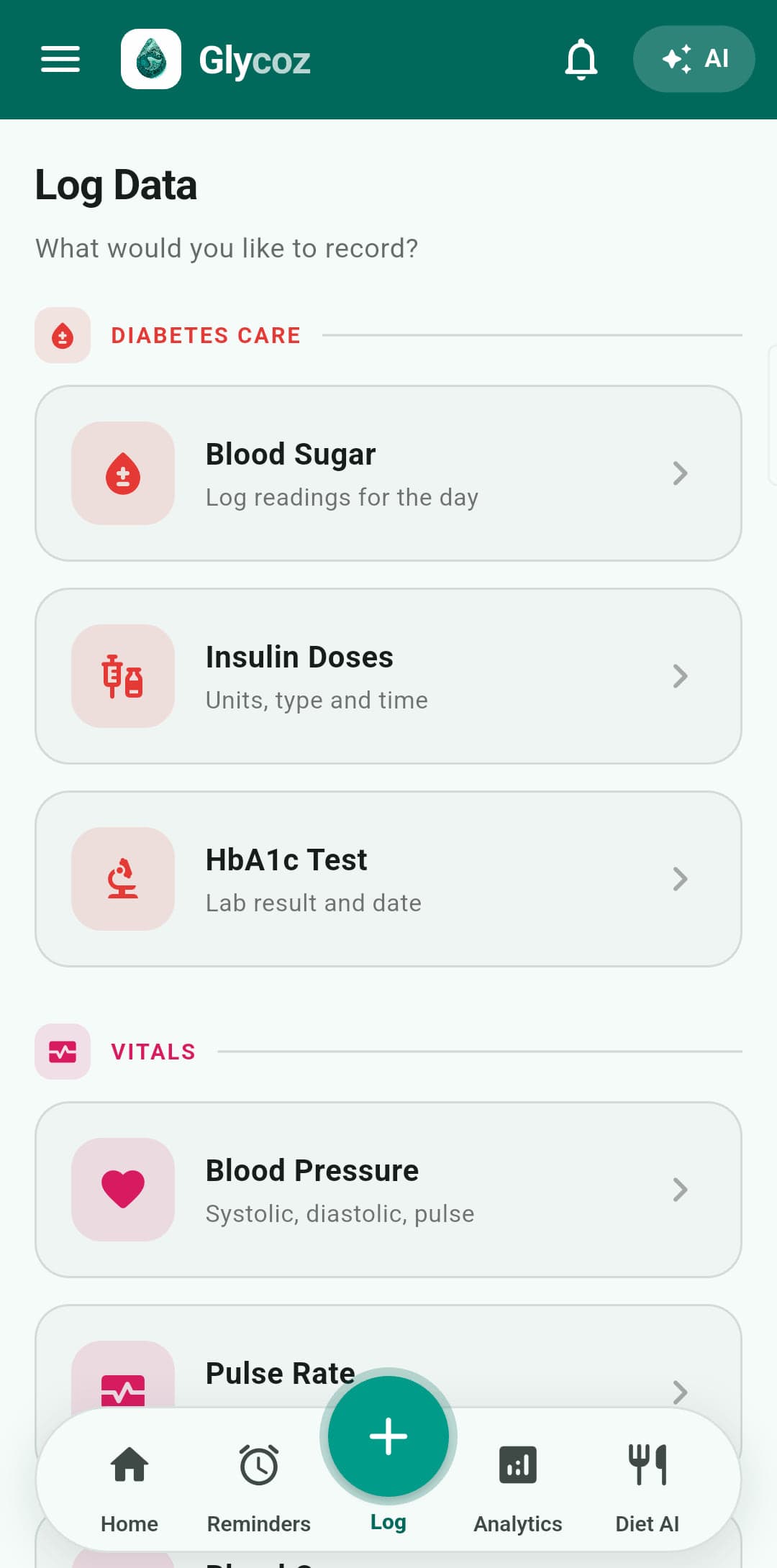
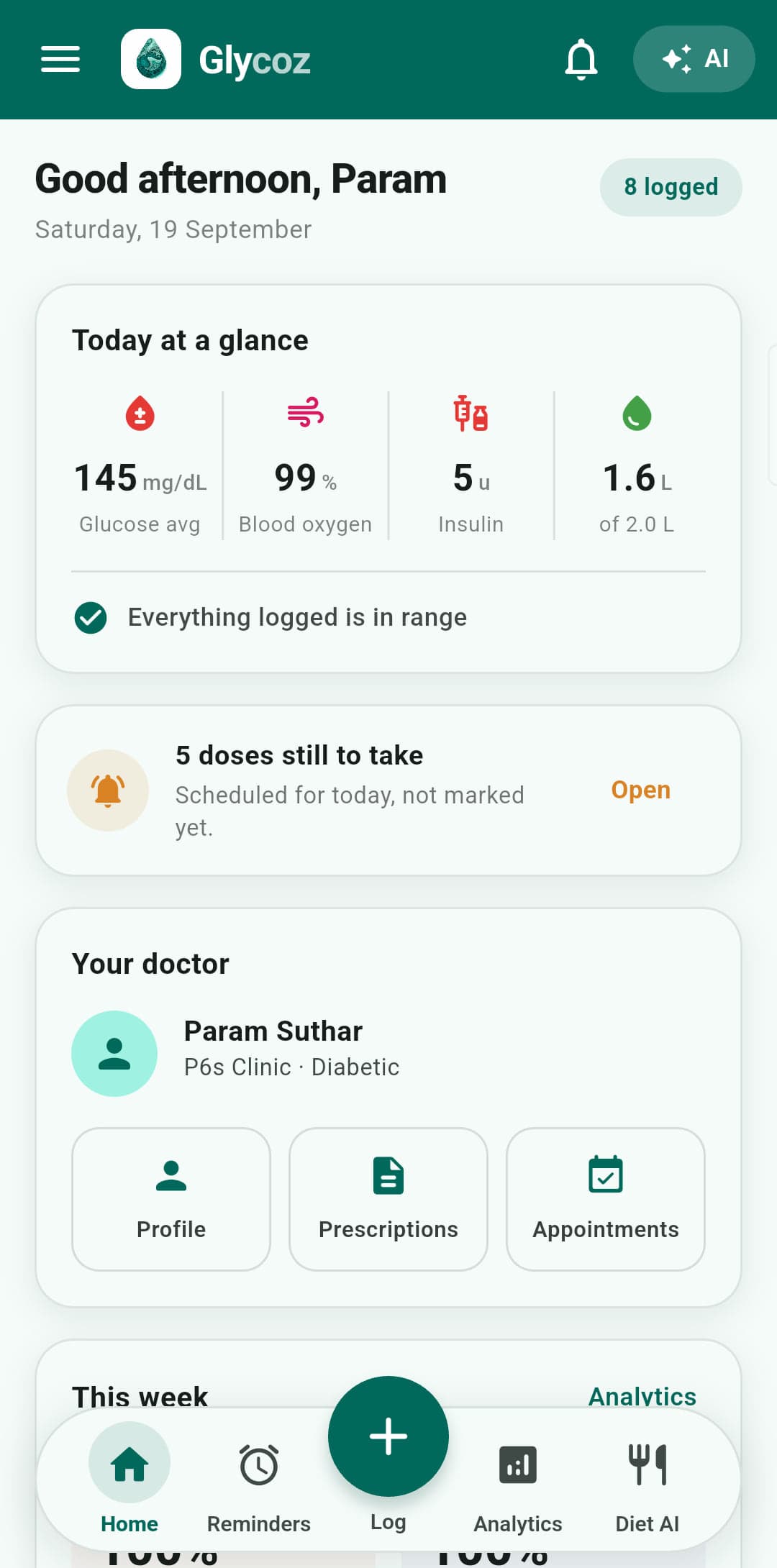
Always on: Blood Sugar Readings, Generate Report, My Care Team, Find a Doctor and Emergency Info. 18 modules in total, and the rest are yours to switch on.
Language
The first question the app asks is which language to ask it in.
English, हिन्दी or ગુજરાતી — chosen once, before signing in and before anything is set up. Every screen you can reach is in the language you picked.
- English
- हिन्दी
- ગુજરાતી
Each one is named in its own script, and the screen follows your finger
The heading, the note and the button change language as you move between the rows — so the screen can be read by the person it is for, rather than only by someone who already reads the language it opened in.
Your phone suggests, it does not decide
Whatever language the handset is set to pre-selects a row, and the question is still asked — a phone set up by a relative is common enough that assuming would be wrong. Change the phone later and the app stays in the language you chose.
Email arrives in it too
The choice is kept with your account rather than with the phone, so what Glycoz sends you is written in the same language. Somebody with two devices is not written to in two languages.
Reminders, in the language you set
The name you gave a medicine stays exactly as you typed it. Glycoz translates its own words, never yours.
A few terms stay in English on purpose
HbA1c, time in range, and the units printed on a meter or a lab report. They are what these things are called in a consulting room, and inventing a local phrase would be a word your doctor has to translate back.
Record
A reading takes about ten seconds.
The number, and when it was taken. Context is what turns a column of figures into something a doctor can read — 160 mg/dL before breakfast and 160 mg/dL after dinner are not the same finding, and an app that does not ask has thrown that away. The same is true of a pulse taken resting and one taken after a walk.
- Before breakfast
- After breakfast
- Before lunch
- After lunch
- Before dinner
- After dinner
- Bedtime
- 3 AM
- The number142mg/dL
- When it was taken
- Before breakfast
- After lunch
- Before dinner
- Bedtime
- 3 AM
One tap. This is the field most apps leave out, and the one that makes the number mean something later.
- SavedBefore dinner142
Written to your phone
No spinner and no connection needed. It syncs later, on its own.
Every state carries a word, not only a colour
Readable on a cheap screen, in sunlight, and by anyone whose colour vision does not separate green from orange. Diabetic retinopathy is common among people living with diabetes, and colour alone is not a message you can rely on reaching them.
- In range
- High
- Low
- Very low
Read it back
Recording is half of it. The other half is being able to read it back.
A list of readings is a list of readings. What makes it useful is the shape it takes over a fortnight, and whether that shape is telling you something about a particular time of day.
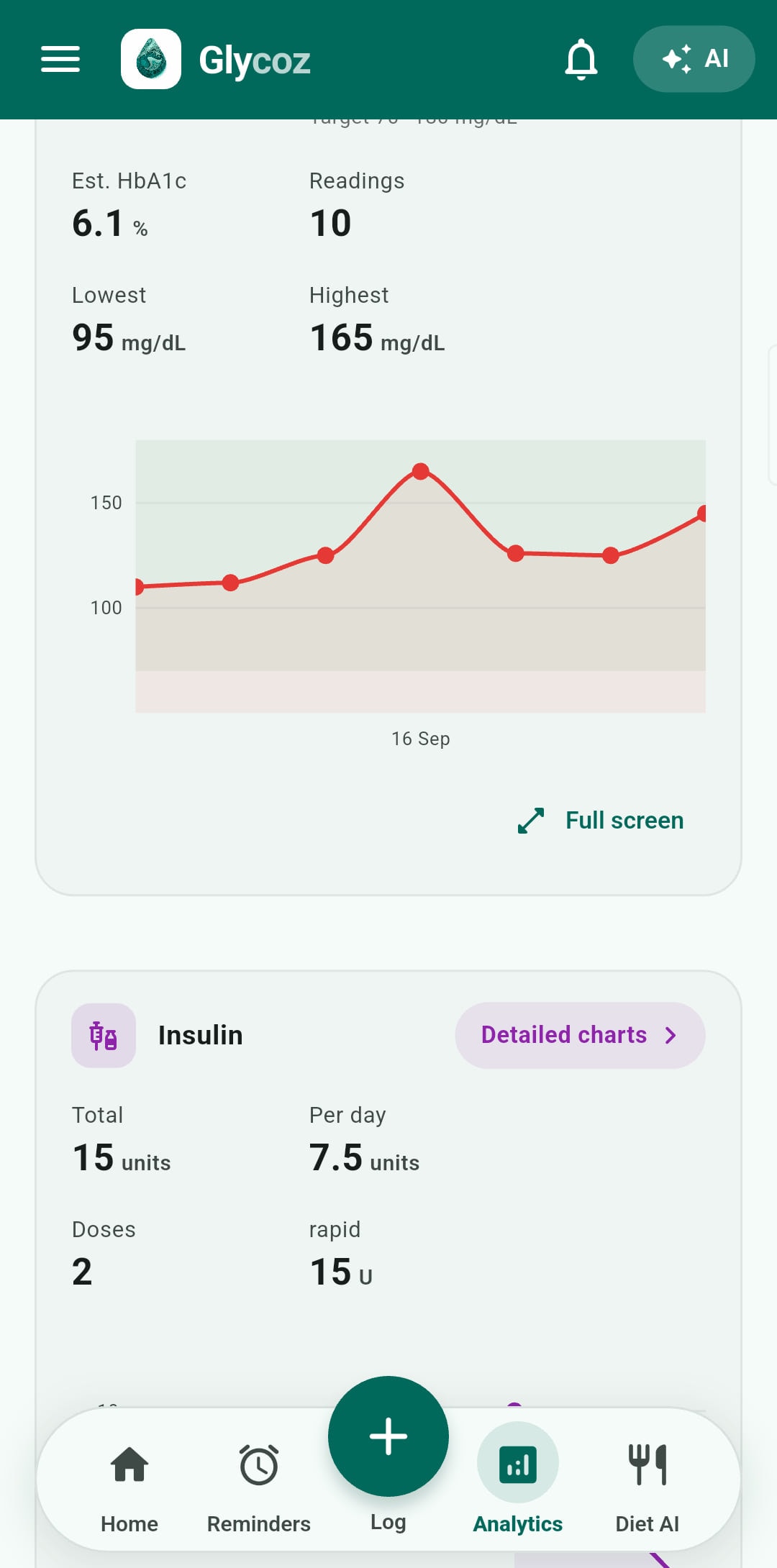
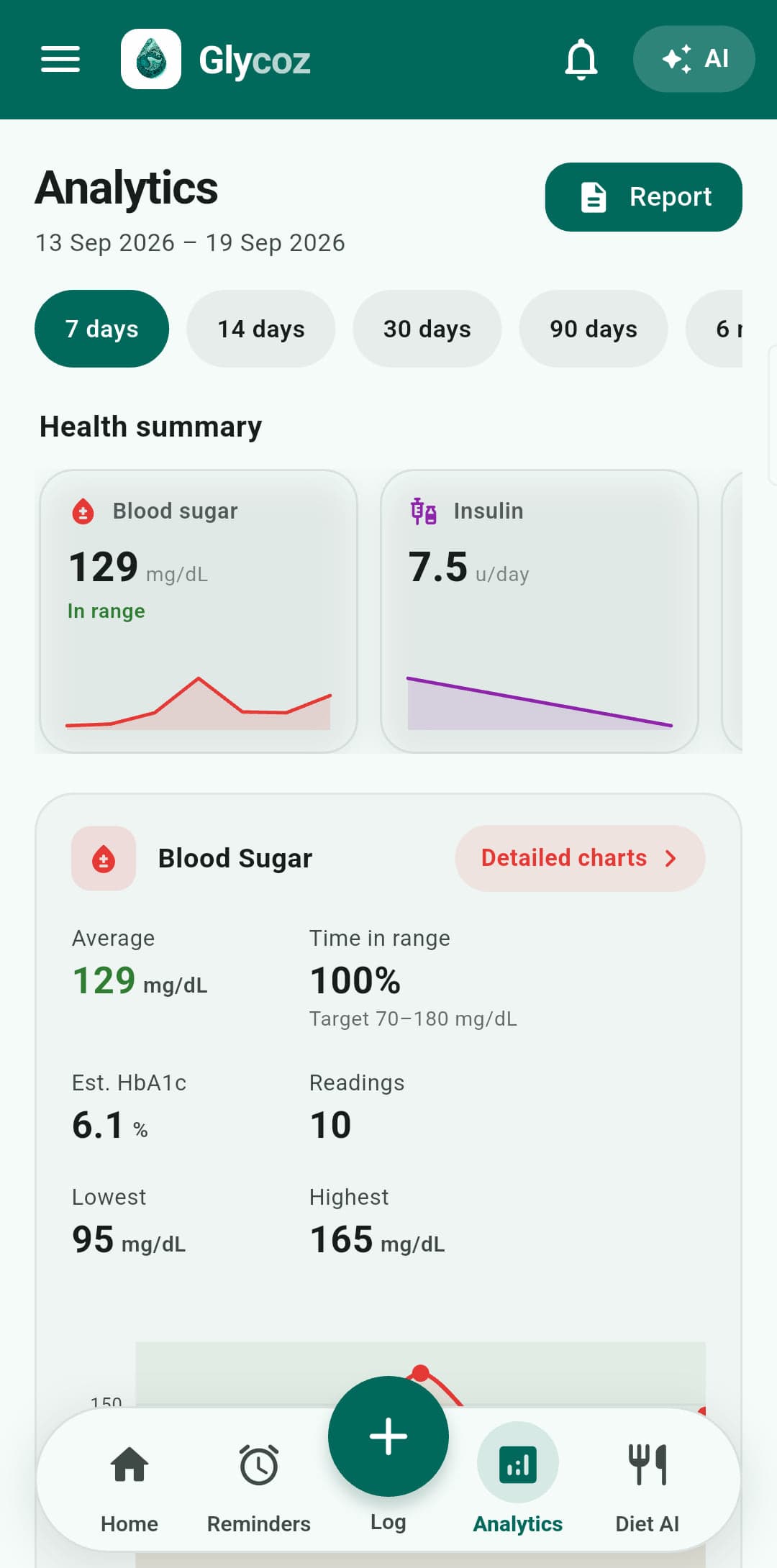
A week, summarised.
- Time in range. The share of your readings that landed inside your target range — 70 to 180 mg/dL unless you have set your own. One number that says more about a fortnight than any single reading does.
- Averages by meal slot. Before breakfast averaged separately from after dinner. A problem that only happens in the evening looks like a problem, rather than disappearing into an overall mean.
- An estimated HbA1c. Worked out from your own readings, so you have a sense of where you are between lab tests. It is an estimate from the numbers you entered — not a substitute for the blood test, and not something to change treatment on.
- Lows, counted. Low and very low episodes are counted rather than buried in the middle of a list. They are usually the readings that matter most and the easiest to lose.
- Every chart, full screen. Turn the phone sideways and pinch. Zoom into a fortnight and the daily readings come back; zoom out to a year and they gather into months. The dates and values relabel themselves as you go.
Glycoz draws what you entered. It does not interpret it, it does not predict, and it will never tell you to change a dose. Every reading it shows you is a reading you or your meter produced.
Medicines
A reminder you can sleep through is not a reminder.
A missed dose is usually not a discipline problem. It is a memory problem, and what helps is something that actually interrupts you at the right moment — then remembers that it did.
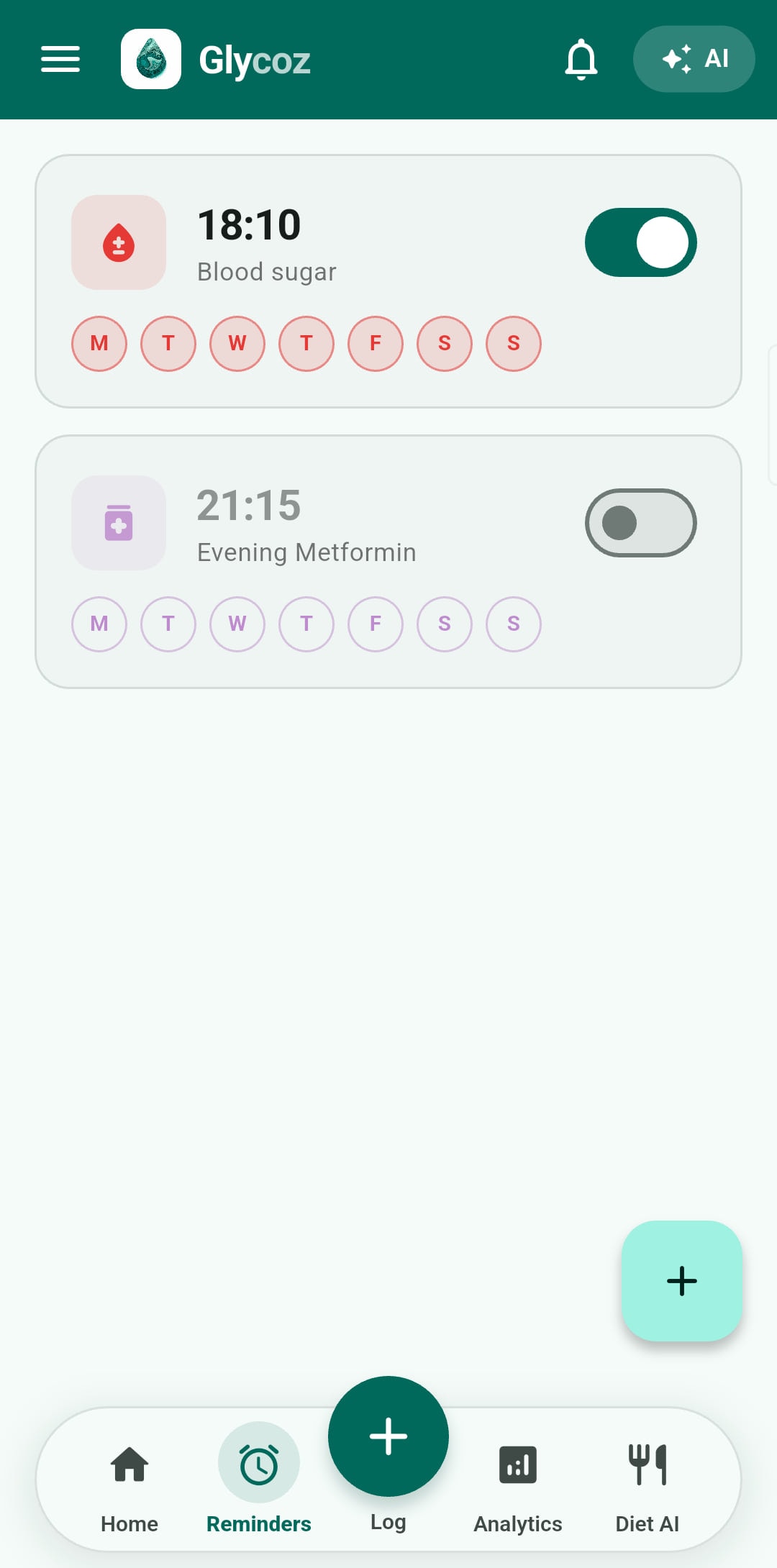
Set once, and then it is the phone's problem.
- It fires when it should. With the app closed, after the phone restarts, and with no internet — because it is scheduled on the device rather than pushed from a server that may not reach you.
- It takes over the screen. The way an alarm clock does, not a notification joining a queue of forty others. Act on it or snooze it without unlocking the phone.
- And it leaves a record. What you marked as taken, and when, is something you can look back at rather than reconstruct in the chair. Your doctor sees the same record, if you share medicines with them.
What it holds
18 modules. You will not use all of them.
They are grouped the way the app groups them. Turn one off and it disappears from your home screen and your reports. What you already recorded is kept, not deleted, and what a doctor can see is a separate switch.
Diabetes Care
Blood Sugar Readingsalways on
Every reading, with the meal it belongs to.
Insulin Doses
Units, type and time of every dose.
HbA1c Tests
Lab results over time, and an estimate from your own readings.
Vitals
Blood Pressure
Systolic, diastolic and pulse, charted together.
Pulse Rate
Resting or after activity — kept apart, because they mean different things.
Blood Oxygen
SpO₂ readings from a pulse oximeter.
Weight
A trend line rather than a daily number to worry about.
Activity
Walking & Running
Steps, distance and pace, tracked as you go. The route stays on your phone.
Cycling
Distance and speed, tracked as you ride. The route stays on your phone.
Wearable
Sleep, steps, pulse and oxygen, read from your watch or band.
Lifestyle
Water Intake
Intake through the day against a target you set.
Diet AI
Photograph a meal and get a nutrition estimate to check against.
Insights & Reports
AI Health Insights
Questions answered from the records you have already entered.
Generate Reportalways on
A PDF or CSV of your records, for the doctor who asks.
My Care Teamalways on
The doctors you have connected, what each can see, and what they send you.
Find a Doctoralways on
Doctors near you, and a way to ask one to connect.
Safety
Emergency Infoalways on
What someone helping you would need to know.
General
Medicines
Your regimen, its reminders, and a record of what you actually took.
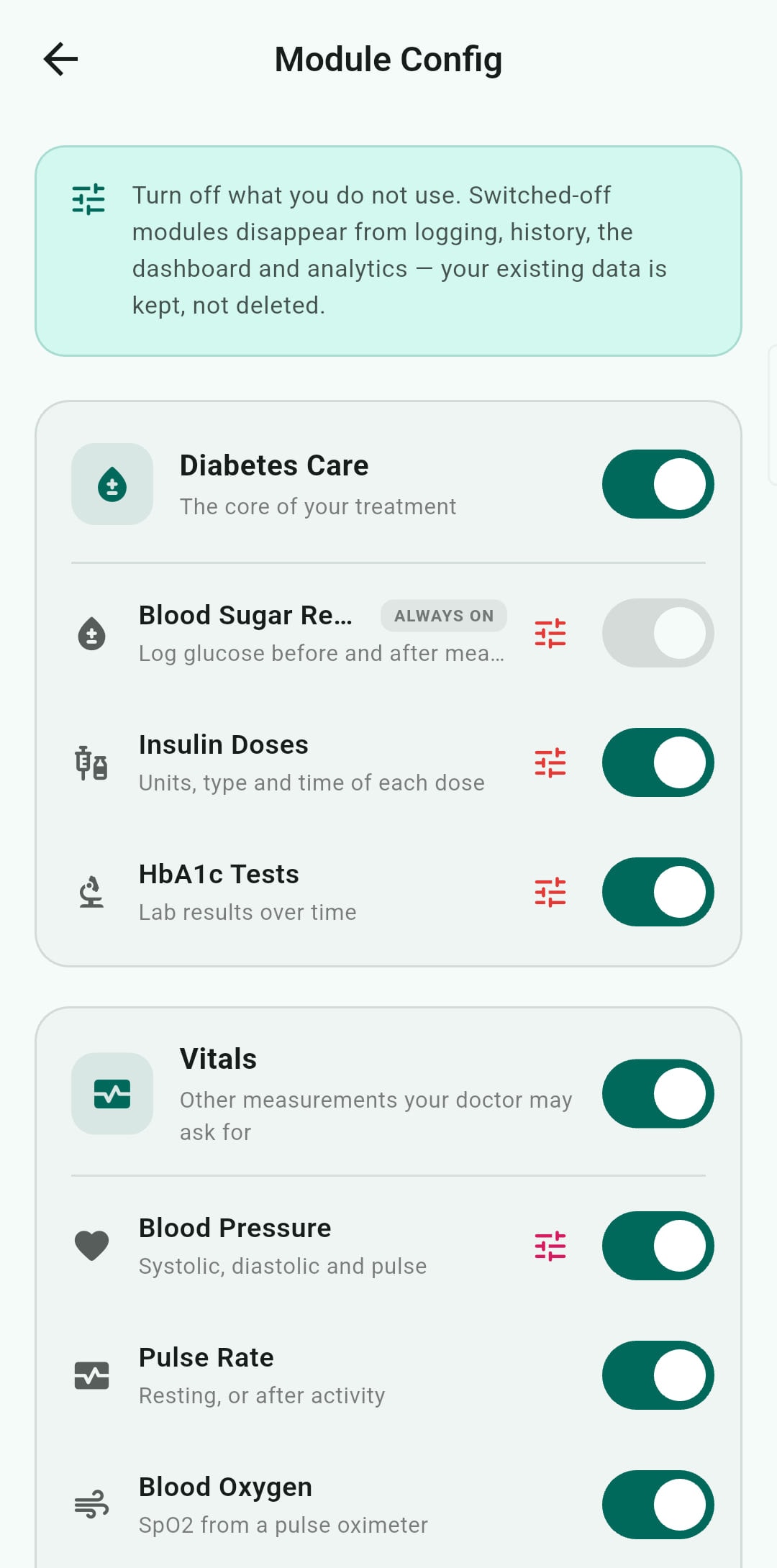
And most of them are a switch.
- A few are always on: Blood Sugar Readings, Generate Report, My Care Team, Find a Doctor and Emergency Info.
- A new account is asked which of the rest it wants, once, when the app is first set up.
- Switching one off removes it from logging, from your history and from your analytics — and keeps what you already recorded.
- It changes nothing about what a connected doctor can see. That is the sharing switch, set per doctor, under Your doctors.
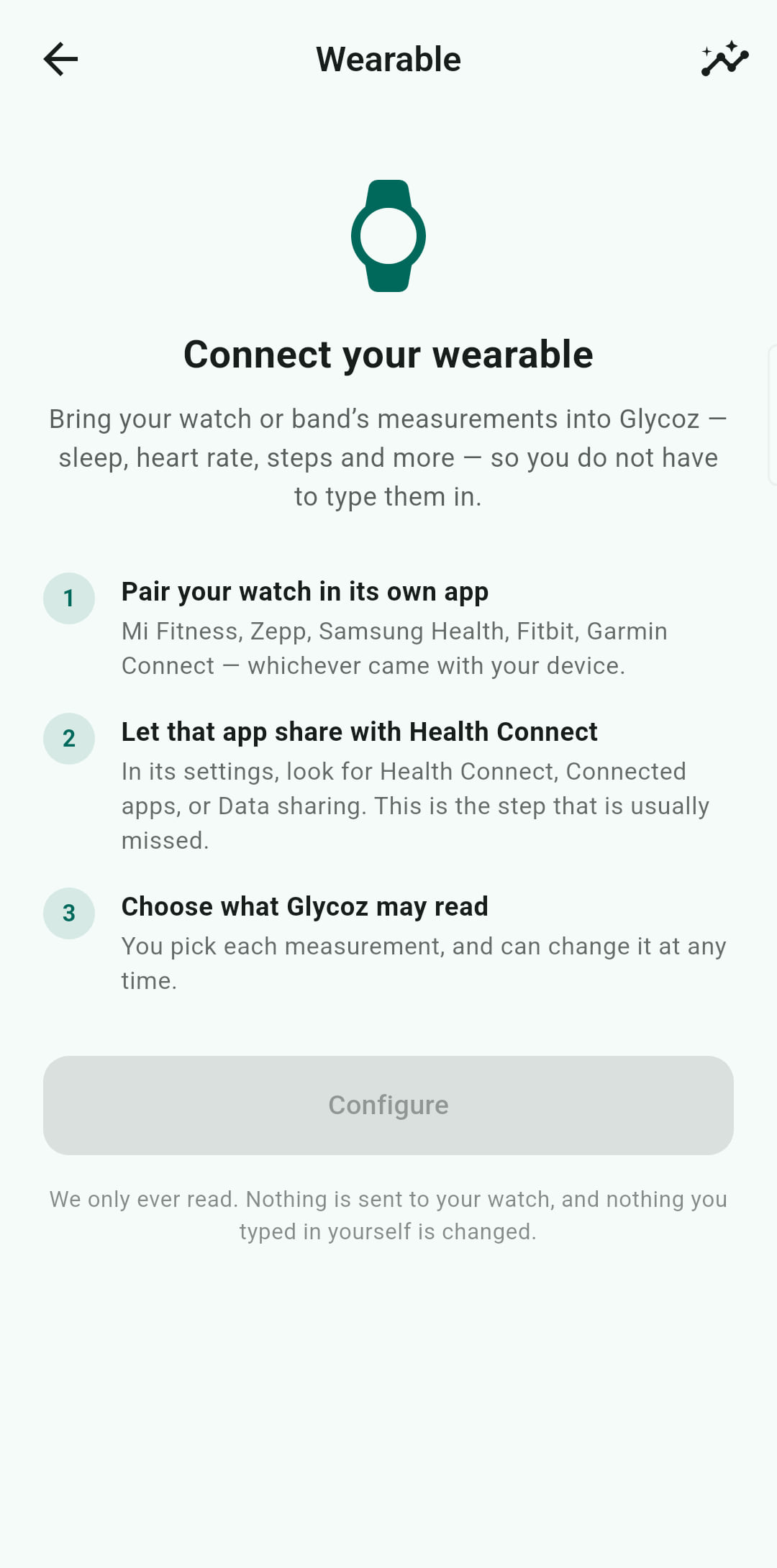
Your watch
And a good deal of it fills itself in.
- It fills in what people give up recording. Sleep, steps, distance, resting pulse and blood oxygen arrive on their own through Health Connect. Nobody sustains typing those in, which is why almost nobody has a year of them.
- It is read-only, and kept apart. Glycoz reads from your watch and never writes to it. What the device reported is stored separately from what you typed, because when the two disagree they are both true and merging them would silently pick a winner.
- You choose the measurements. Each one is a separate permission, decided before anything is read and changeable at any time. Glycoz reads when you open the Wearable tab, never in the background — switch the module off and there is no tab and nothing is read at all — and disconnecting removes everything it imported.
Where the route goes: nowhere. A walk or a ride syncs its distance and its duration; the path you took stays on the phone. Where somebody walks is not a health measurement.
Reports
The printout your doctor asks for.
Not every doctor will use the panel, and not every appointment is with a doctor you have connected. Glycoz builds the document instead — the one that would otherwise be a photograph of a notebook page.
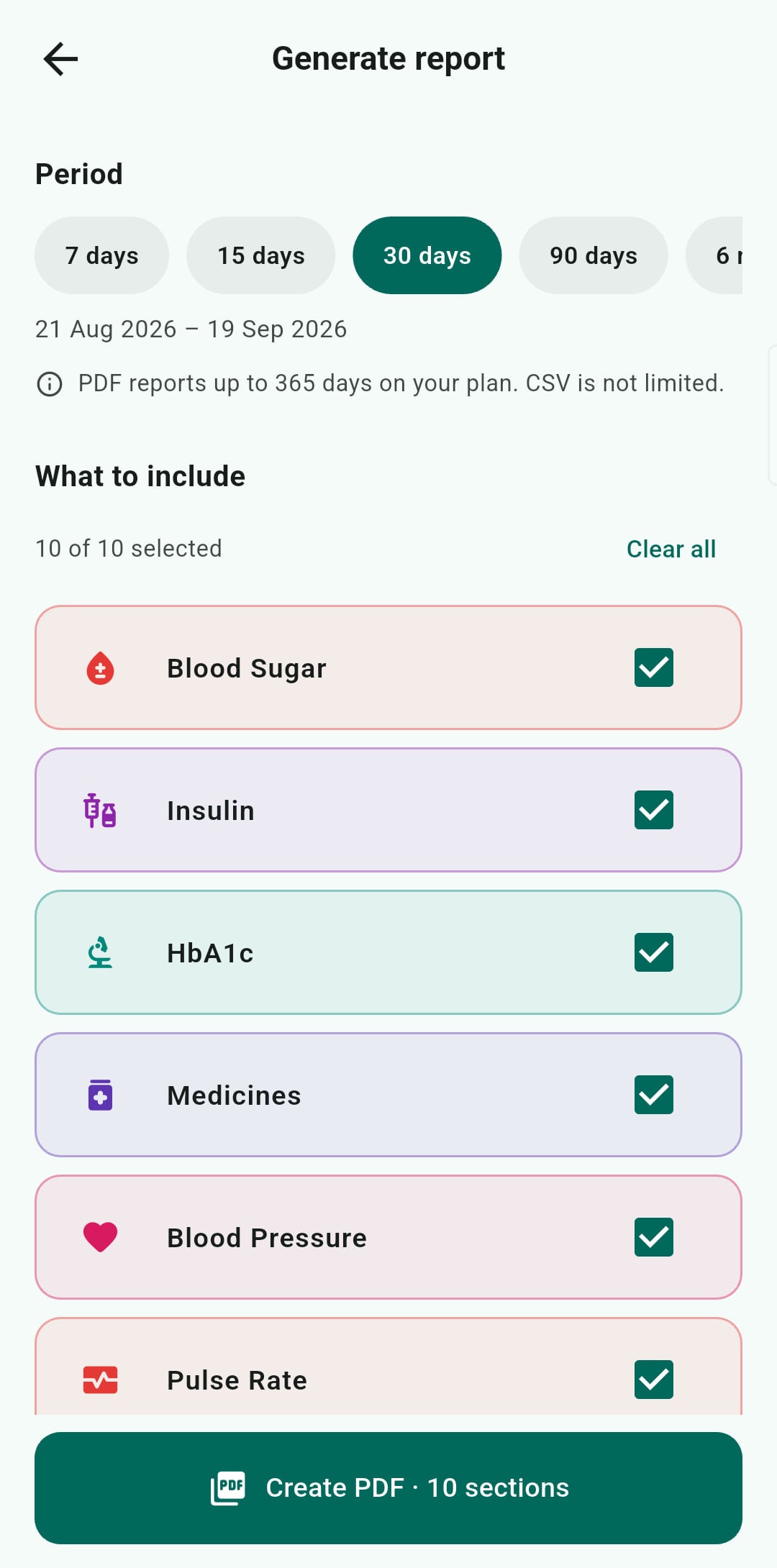
Pick the period, pick the sections, get the PDF.
- The period you need. The fortnight before an appointment as a PDF, or the whole year as a CSV.
- Only the sections you pick. Blood sugar alone, or the vitals alongside it. You decide what goes in before it is generated.
- PDF to read, CSV to work with. One for the consulting room, one for anyone who wants the numbers themselves.
- Sent the way people actually send things. WhatsApp or email. Whoever receives it needs no app, no account and no login.
Heart rate is summarised on resting readings only, because an average taken across a nap and a brisk walk describes neither of them.
Meals
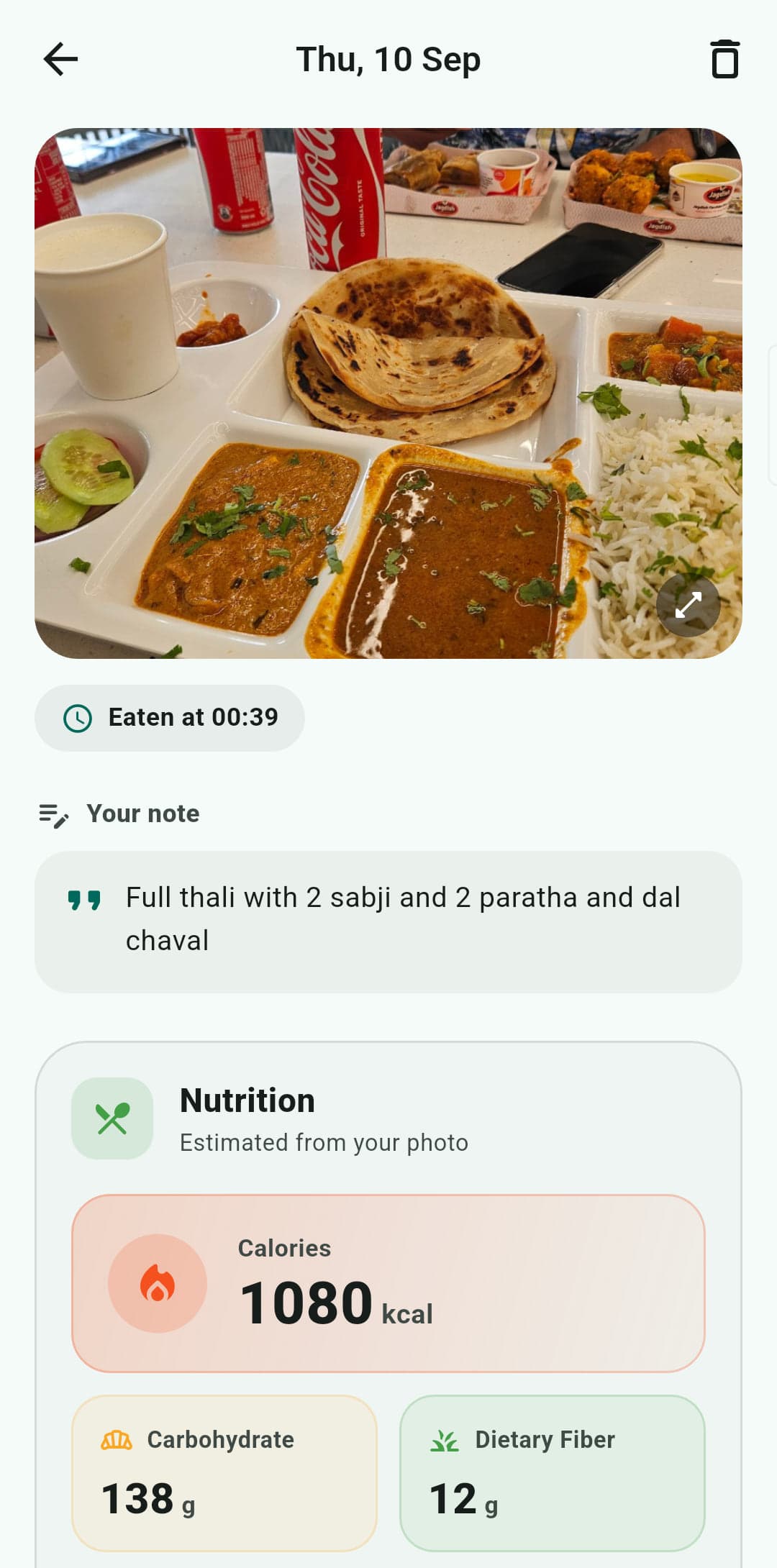
A photograph of a plate, and an estimate to check against.
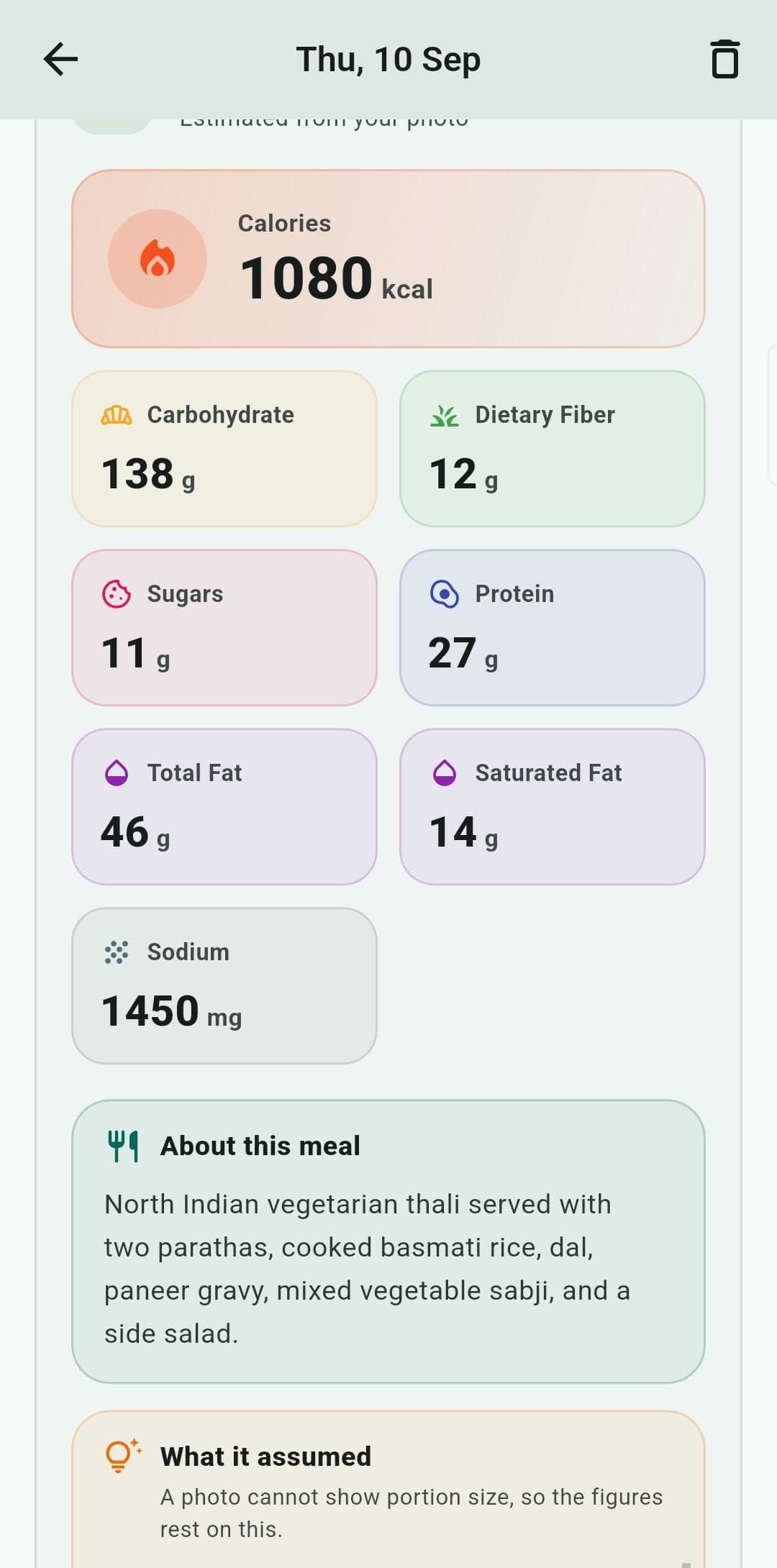
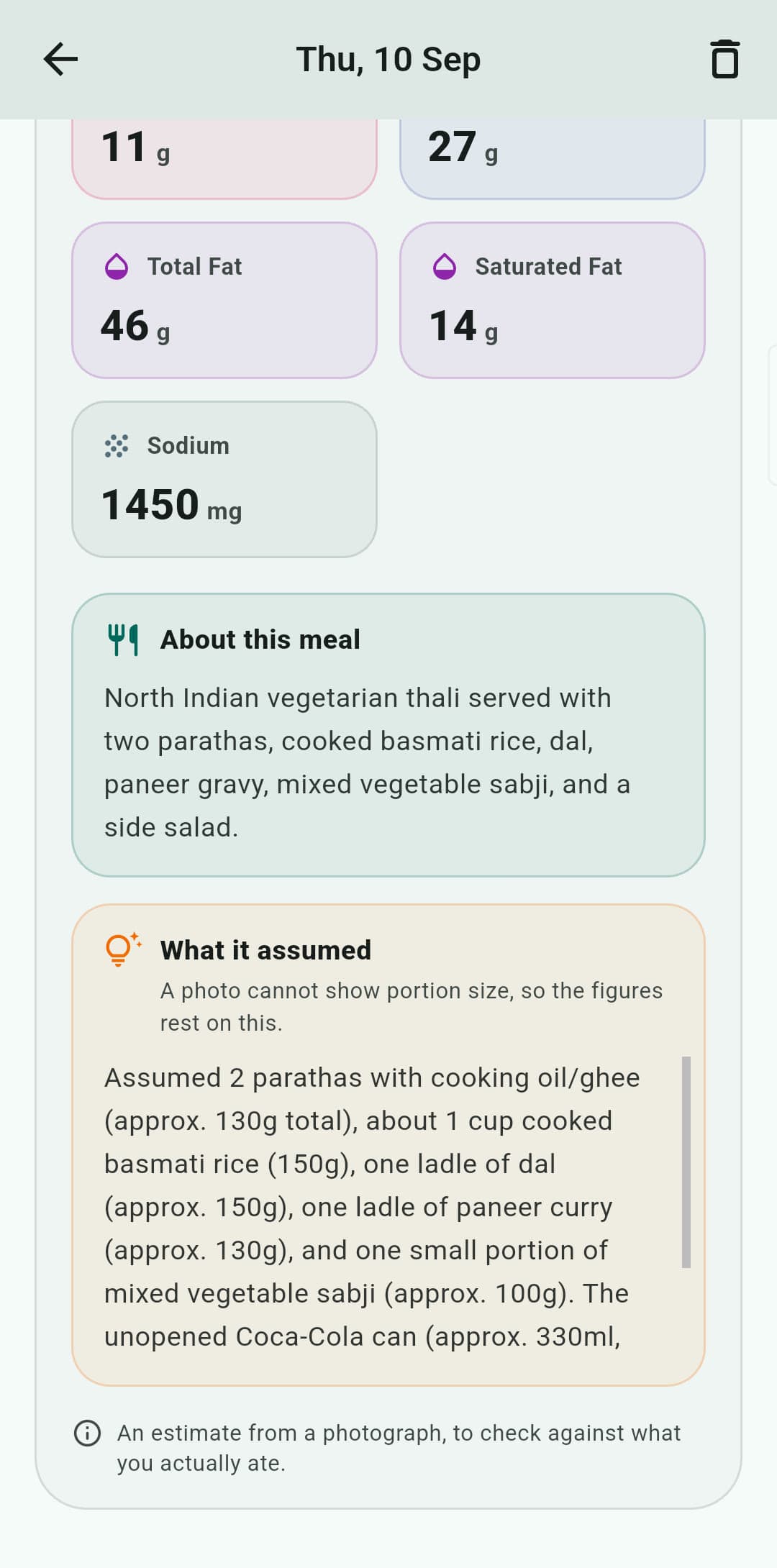
Photograph what you are about to eat and add a note if you like. Diet AI works out a nutrition estimate: calories first, then carbohydrate, sugar, protein, fat, fibre and sodium, what it thinks the dish is, and what it had to assume — usually the portion.
- An estimate, not a measurement
- It is worked out from a photograph, so it says what it had to assume and it is there to check against, not to count on. Nothing about a dose or a medicine should change because of it.
- The photograph stays yours
- It is uploaded to your account, so it comes back on a new phone, and the server removes its location and camera details before it is stored. A doctor you share Meals with sees your note and the estimate — never the picture.
- Logging a meal is never locked
- A meal, its photograph and its note are always saved. The estimate is part of Glycoz Premium, after a few free tries; a meal without one simply says it was not analysed.
What leaves your phone: to make an estimate, the photograph and your note go through our server to an outside AI provider. The next stop says the same about the assistant, and a doctor’s own assistant sends figures from the areas you share with them — all of it set out on the privacy page.
The assistant
Ask questions about your own data.
“What was my average before dinner last month?” “Which day was worst this week?” It can answer because it can read the readings you entered — and only those.
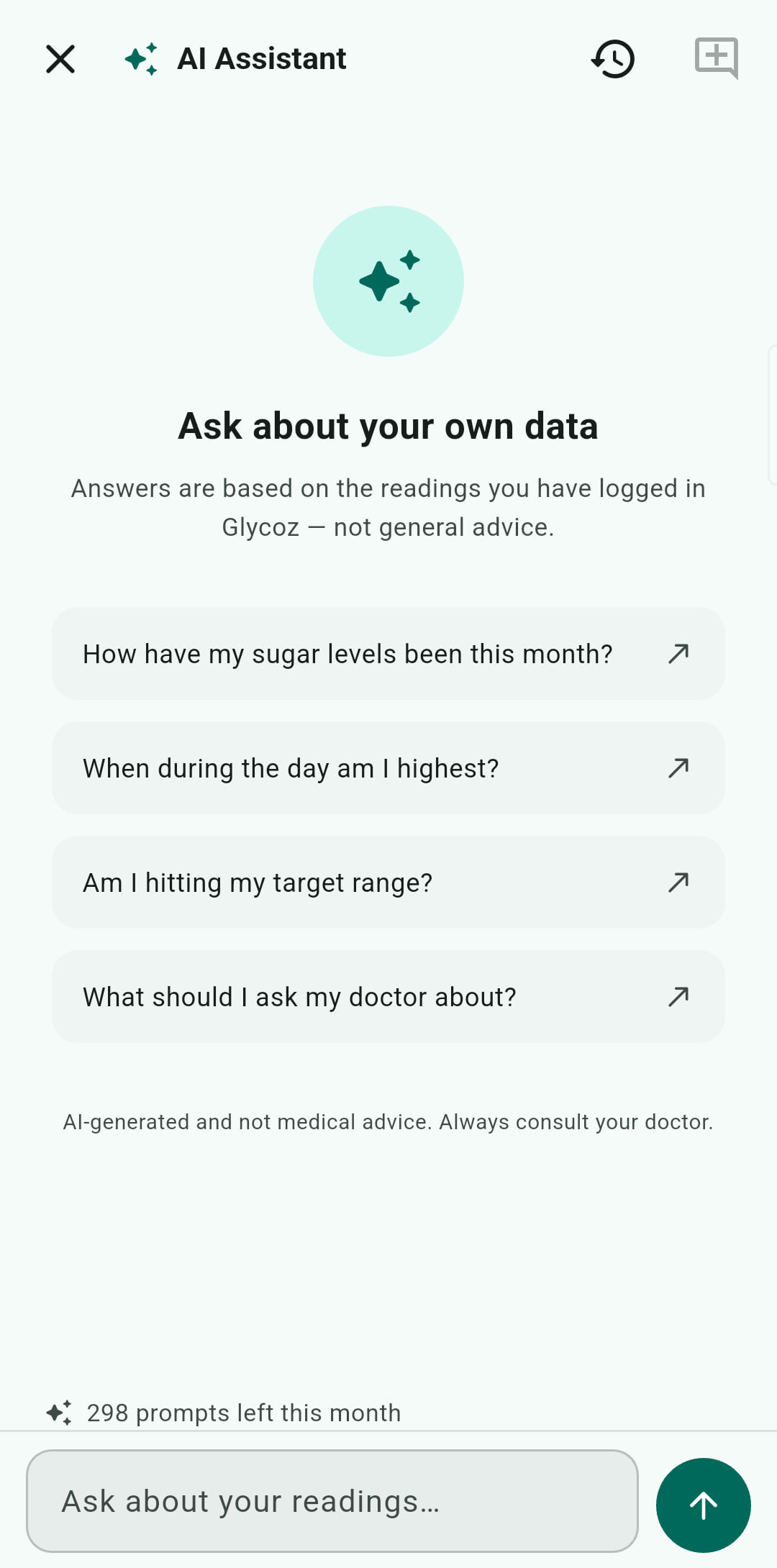
What you should know before you use it.
- Answering happens on our server, not on your phone. Your question, and the records relevant to it, are sent to an outside AI provider to be answered. Your name, email and phone number are not.
- Your conversations are never visible to any doctor — not as a setting you could get wrong, but because there is no permission for them and no screen in the panel that could show one.
- If you would rather none of that happened, switch the module off and the rest of the app is unaffected.
- It is part of Glycoz Premium, alongside meal estimates and longer PDF reports. Every account gets a few free tries first; after them, you ask for Premium in the app.
And a hard limit.
It does not diagnose, it does not predict, and it will not tell you to change a dose. Where your record shows a severe high or a severe low, seek-care wording is added to the answer by the system itself rather than left to the model to remember.
Your doctor
Sharing is a decision you make, once you want to.
Your doctor gives you a code. You enter it inside your own account. You choose what they can see, one area at a time, and you can end it in a tap — immediately, and without a conversation about it first.
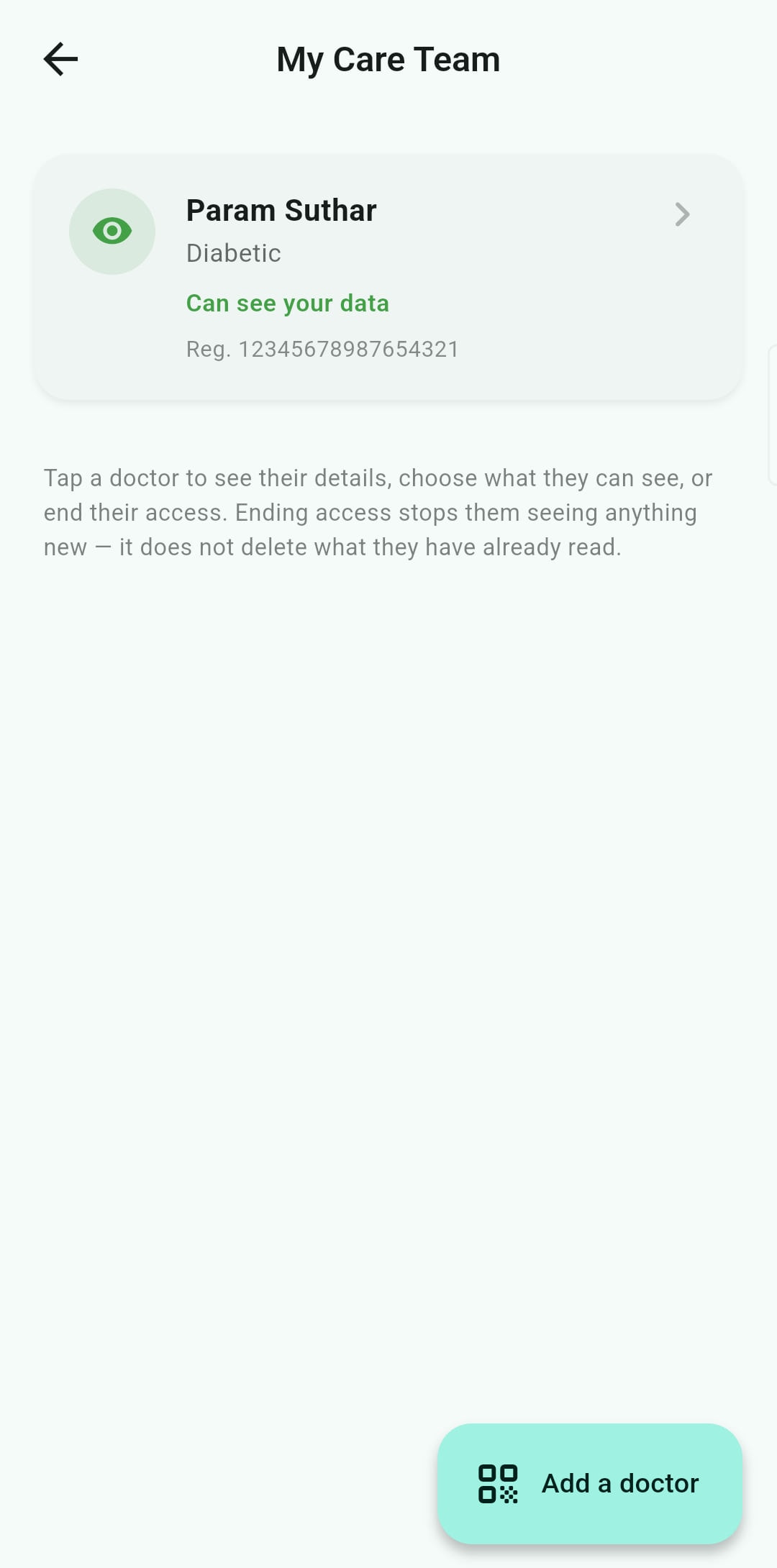
A list you built, and nobody else can add to.
- A doctor appears here because you entered a code they gave you, inside your own account — or because you asked them to connect and they accepted.
- There is no screen anywhere in the product that lets a doctor add themselves to your care team.
- You can see their registration number and their clinic before you decide anything.
- Ending their access is one tap, takes effect immediately, and needs no conversation first.
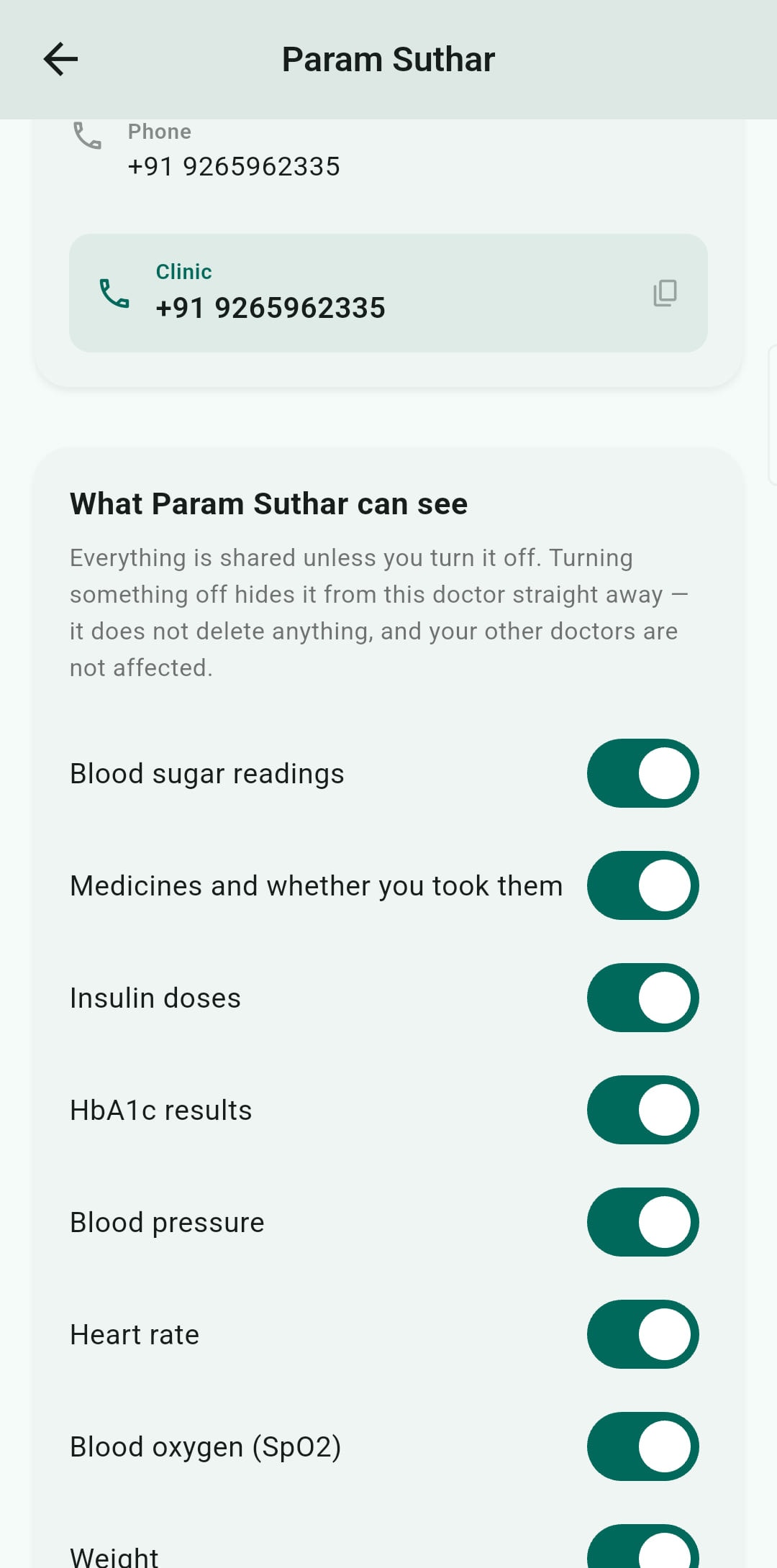
And exactly what each of them can see.
- One switch per area — readings, medicines, insulin, pressure, weight, activity, meals and the rest.
- The switches are per doctor. Turning something off for one changes nothing for another.
- A withheld area is not an empty chart for them. They are told it is not shared, and the server sends none of it — on their dashboard and patient list too.
- Turning one off deletes nothing from your own record.
Sharing starts on for every area when you connect somebody, and the app tells you so on a screen you agree to first. An area added to Glycoz after that starts off for doctors you were already connected to — you were never asked about it, so it waits for you to switch it on.
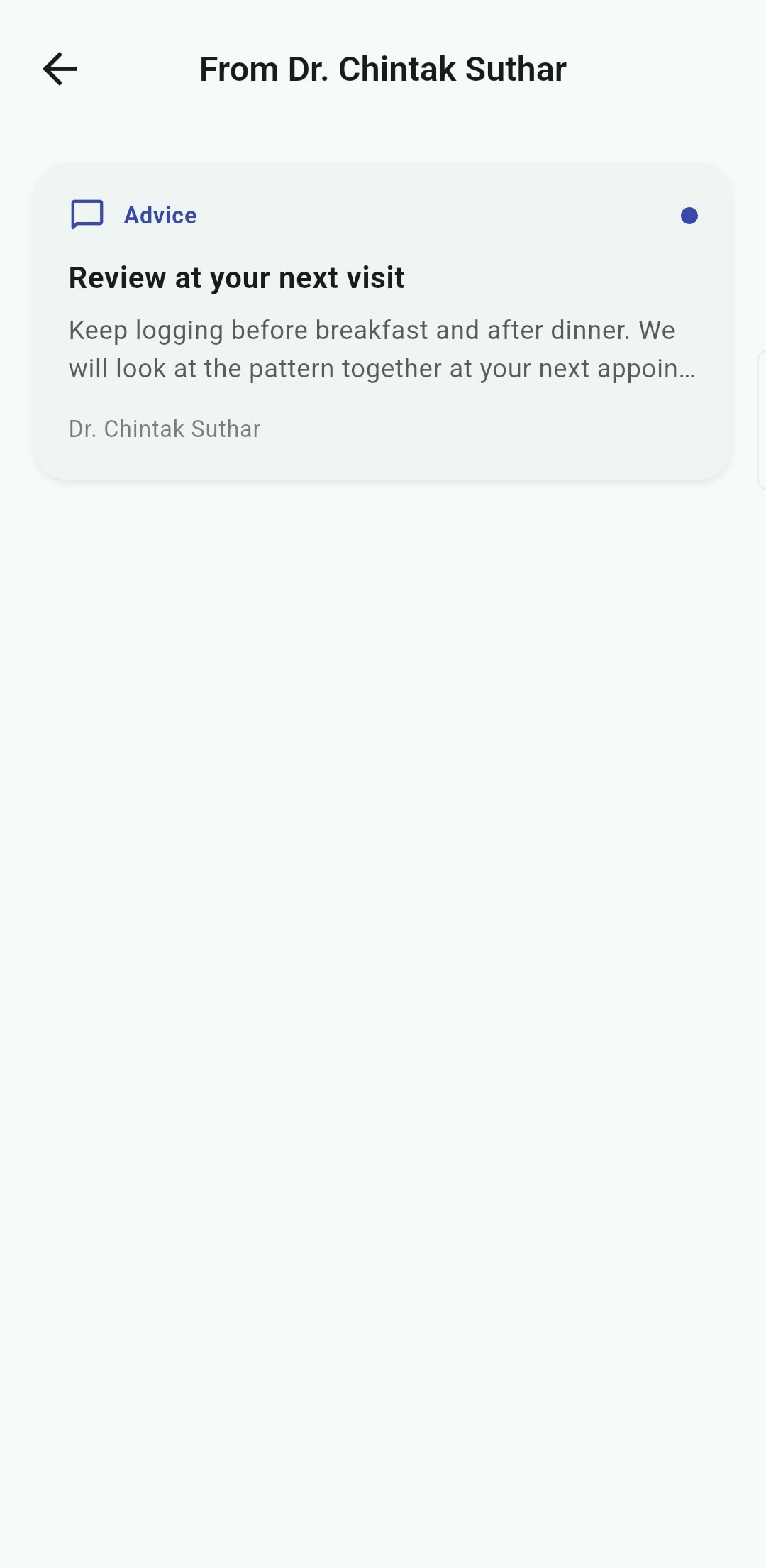
What they write to you lands on your phone.
- Prescriptions and advice arrive under “From Your Doctor”, where you can mark that you have read it.
- It survives you reinstalling the app, and it stays yours if you later end their access.
- Their private notes about you never arrive — there is no route in the system that carries them.
What the connection actually gives you
- Appointments, from their actual diary
- You see the times their clinic has free, ask for one, and hear back in the app. It needs a connection — a diary you booked offline would be a diary that double-books, and the app says so rather than pretending.
- An emergency alert, when you need one
- The button is on a doctor's card, and it tells that doctor you need help, by email and a notification. It does not call an ambulance and it does not reach emergency services — and if it cannot be sent, the app says so and tells you to phone, rather than showing you a tick.
- One inbox for what arrives
- Prescriptions and appointment changes, in one place in the app rather than scattered through your notifications.
- And a notification that gives nothing away
- When your doctor sends something, the alert on your lock screen says that they sent something — never what. The words come from the database on your phone, after you unlock it, because a push notification crosses Google's servers to reach you.
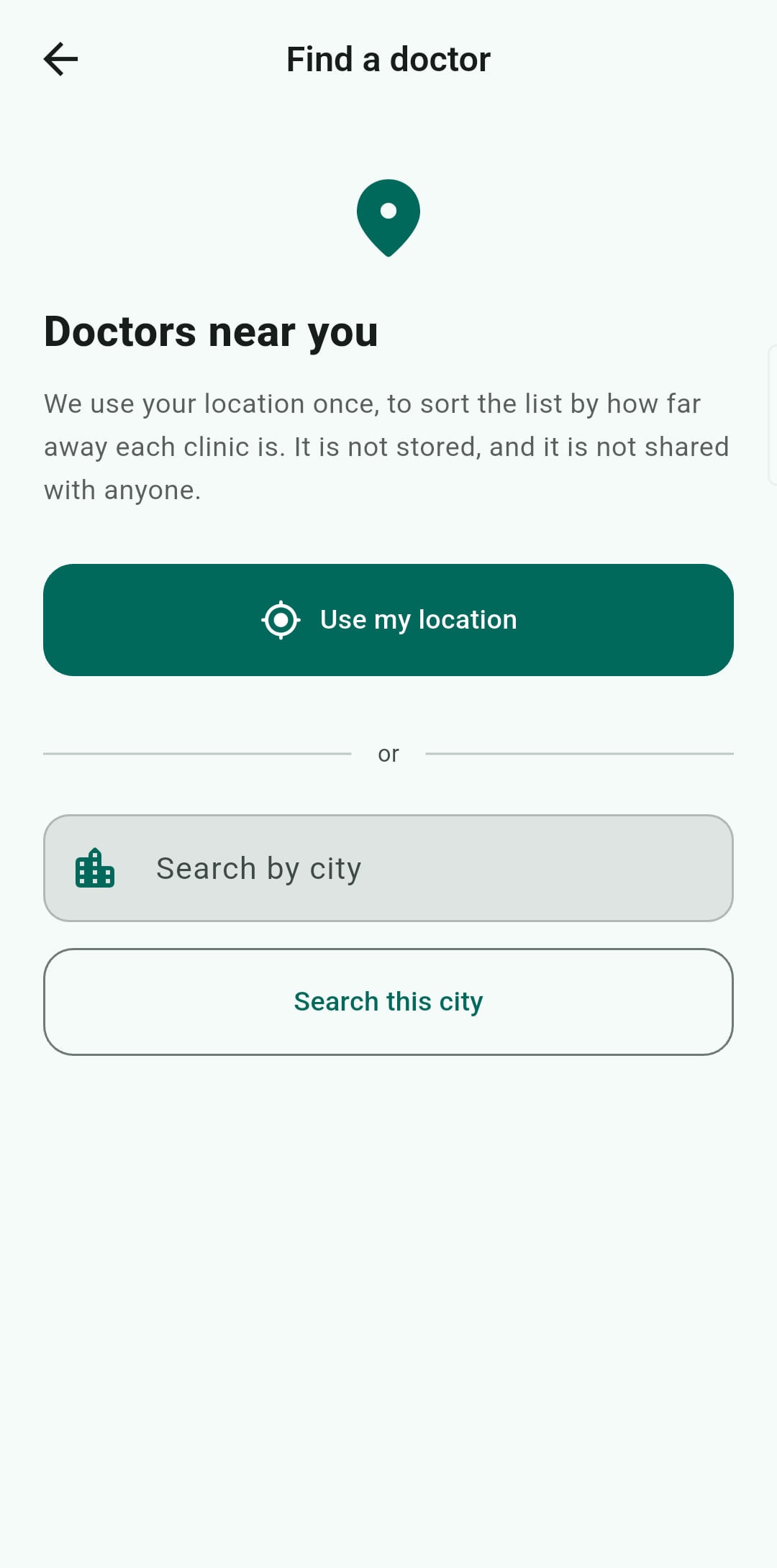
And if your doctor is not on Glycoz.
- Find a Doctor shows doctors near you, or in a city you choose, sorted by how far away each one is.
- Your location is sent with the search to sort the results. It is not saved with your account, and it is not shared with anyone.
- Only doctors whose registration has been checked, and whose practice has chosen to be listed, appear — so the directory is new, and may have nobody near you yet.
- The report is there for every doctor who is not on it — no account needed at their end.
Offline
Signal is optional. Your record is not.
Sign in once. After that Glycoz keeps working in aeroplane mode, in a lift, in a village with one bar — because the app writes to a database on the phone rather than to a server. When you are back online it syncs quietly: your records go up as a backup, anything logged on another device comes down.
- Your history follows the phone, not the other way round
- Sign in on a new device and your records come back from your account — all of them except walk and ride routes, which never leave the phone they were recorded on. That is what the account is for.
- Take a copy whenever you like
- A PDF to read, or a CSV of the records themselves, made on your phone and sent wherever you choose. You do not have to ask for it and you do not have to wait for it.
- Ask to be erased, and keep the right to change your mind
- From Settings › Your data. Nothing changes for 30 days and you can withdraw the request; after that the account is erased by itself. It can be asked for without the app, too.
Two properties worth being exact about
- A record is copied to the server when it syncs, not moved. The phone keeps the whole history whether or not you ever go online again.
- Delete a reading on one phone and it stays deleted everywhere, rather than reappearing at the next sync from a device that had not caught up.
Questions
Questions people ask before installing
What does it cost?
Do I need an account?
Does it really work without internet?
Does my doctor see everything?
What happens if I lose my phone?
Is there an iPhone version?
Can I use it for type 1, type 2 or gestational diabetes?
I am not diabetic. Is it any use to me?
Start
Start with today.
Free to record and to share, no advertising, and useful before you have connected anybody. Android only, and in early access.
Glycoz is a record-keeping and communication tool. It does not provide medical advice. It is not intended to be used as a medical device, and has not been assessed as one. If you have symptoms of a severe low or a severe high, treat it and get medical help. Do not open an app first.